Managing payroll in India has turned into a real challenge, especially when it comes to HR and payroll challenges. Organizations manage multiple issues at a time, like different pay structures, varying taxation laws, attendance monitoring, increased compliance, and most importantly, employee satisfaction. Any mistake could result in hefty fines, late salaries, and displeased employees.
That’s why so many businesses are turning to payroll management software. It lessens a lot of pressure by automating calculations, keeping you compliant, and streamlining HR tasks.
With a best payroll software, you don’t have to waste hours on manual work. You get accurate results, your employees will receive their payments in time, and worries regarding payment will be a thing of the past. Regardless of whether you manage a small-scale startup company or even a large retail organization, an intelligent payroll system ensures that everything stays under control.
Why Payroll Management is Challenging in India
Payroll management is more complex for Indians because each state has its own rules for labour laws, taxes, and other related issues. For companies that have multiple places to operate, payroll management becomes difficult because of issues related to salaries, PF deduction, ESI contribution, and professional tax.
Employees are classified into different categories such as full-time, interns, contractual, consultants, and remote-working staff members. For different categories, there are different payroll needs.
Without an effective payroll management system, many problems arise.
Common Payroll Challenges in India
| Payroll Challenge | Business Impact |
| Statutory Compliance | Penalties and legal issues |
| TDS Calculation Errors | Tax notices and employee complaints |
| Attendance Integration | Incorrect salary calculations |
| Multi-State Payroll | Complex operational management |
| Manual Payroll Processing | Time loss and higher error risk |
| Salary Structure Complexity | Employee confusion and disputes |
Challenge 1: Managing Statutory Compliance
Statutory compliance is one of the most significant payroll issues in India. Companies have to ensure that they take care of their employees’ PF, ESI, professional tax, labor welfare fund, gratuity, bonuses, and deductions properly.
Since each state has its own set of statutory compliances and deadlines, missing those or miscalculating can lead to penalties. Payroll management software will help companies handle statutory compliances and report generation easily. The best payroll management software also updates tax and labour law changes regularly.
How Payroll Management System Software Helps
- Automatically calculates PF, ESI, and professional tax deductions.
- Reduces compliance errors and filing delays significantly.
- Updates payroll rules according to latest government regulations.
- Generates challans and compliance reports quickly and accurately.
Challenge 2: TDS Calculation and Tax Management
TDS calculation has become more complex after the introduction of old and new tax regimes. Businesses must calculate tax deductions correctly according to employee declarations and salary structure.
Manual TDS management often creates calculation mistakes and employee complaints during tax filing season.
A payroll management system software automates TDS calculations and helps businesses manage tax compliance efficiently. Employees can also upload investment declarations and tax proofs through employee self-service portals.
Benefits of Automated Tax Management
| Feature | Benefit |
| Automated TDS Calculation | Reduces tax calculation errors |
| Tax Regime Management | Supports old and new regimes |
| Investment Declaration | Simplifies employee tax submissions |
| Form 16 Generation | Improves tax filing accuracy |
Challenge 3: Attendance and Leave Integration
Most companies use manual methods for controlling their attendance and leave administration systems. This results in inconsistencies in salaries, wrong deductions, and conflicts among employees. The Human Resource Department finds it increasingly harder to monitor overtime hours, late arrivals, unauthorized leaves, and shift work manually.
The HR payroll software is designed to incorporate all these operations into one package. Approved leaves and attendance records automatically reflect in salary calculations.
Benefits of Attendance Integration
- Automatic attendance syncing improves payroll accuracy greatly.
- Leave deductions calculate automatically without manual intervention.
- Overtime and shift calculations become faster and more accurate.
- Employees can track attendance and leave balances easily online.
Challenge 4: Multi-State Payroll Management
Businesses operating across multiple states face different payroll rules, professional tax slabs, and labour regulations. Managing payroll separately for each location increases complexity and confusion.
Without centralized systems, businesses often face reporting errors and inconsistent salary processing.
The best payroll management software helps businesses manage multi-location payroll operations from one platform. It automatically applies location-based payroll rules and compliance calculations, addressing key HR and payroll challenges.
Multi-State Payroll Benefits
| Feature | Business Benefit |
| State-Wise Rules | Applies correct compliance automatically |
| Centralized Dashboard | Improves payroll visibility and reporting |
| Multi-Location Management | Simplifies payroll across branches |
| Automated Compliance | Reduces operational confusion |
Challenge 5: Manual Payroll Processing
Many small and medium businesses still use spreadsheets for payroll processing. Manual calculations increase the risk of salary errors, delayed payments, and compliance issues.
One wrong formula can affect payroll for hundreds of employees. Manual payroll also consumes a lot of HR time every month.
A payroll management system automates salary calculations, deductions, reimbursements, bonuses, and pay slip generation, helping organizations overcome common HR and payroll challenges. This improves efficiency and reduces repetitive administrative work..
Benefits of Payroll Automation
- Automated payroll processing saves HR time and effort greatly.
- Salary calculations become faster and more accurate monthly.
- Payslip generation and salary disbursement become fully streamlined.
- Payroll reports improve business planning and financial management.
Why Businesses Need the Best Payroll Management Software
The ideal payroll management software should enable companies to maximize accuracy, compliance, and overall improvement of the employee experience simultaneously. In today’s world, modern payroll systems facilitate the payment process while minimizing workload on the HR staff.
Companies are able to automate their calculations, keep track of attendance records, calculate taxes, and prepare relevant reports through just one software. This increases efficiency and lets HR staff concentrate on other important tasks.
Important Features Businesses Should Look For
| Feature | Main Advantage |
| Payroll Automation | Reduces manual processing work |
| Compliance Management | Improves statutory compliance accuracy |
| Employee Self-Service | Allows employees to access payroll details |
| Attendance Integration | Improves salary calculation accuracy |
| Real-Time Reporting | Supports better payroll analysis |
| Cloud Access | Supports remote payroll management |
How HR Payroll Software Improves Employee Experience
The employees require accurate salaries and clear payroll information every month. Late salaries and miscalculated salary reductions affect employee happiness.
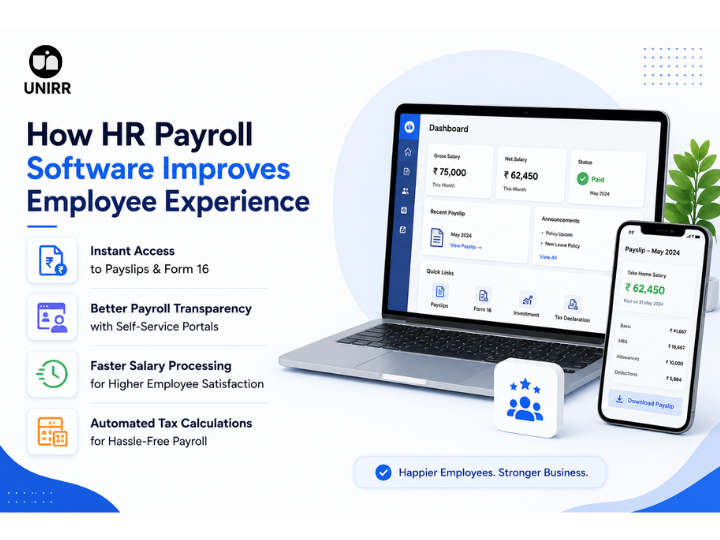
An HR payroll software enhances the experience of an employee through self-service portal access, digital payslips, tax papers, and an attendance tracking system. Employees can access salary details anytime without contacting HR teams repeatedly.
Employee Benefits of Payroll Management Software
- Employees can download payslips and Form 16 instantly online.
- Self-service portals improve payroll transparency and communication.
- Faster salary processing improves employee trust and satisfaction.
- Automated tax calculations reduce employee payroll confusion significantly.
How Payroll Management Software Saves Time and Cost
Manual payroll management consumes a large amount of HR time every month. Businesses also spend additional money correcting payroll errors and handling compliance penalties.
A payroll management system software automates repetitive payroll tasks and reduces operational costs significantly. HR teams can focus more on strategic business activities instead of manual calculations.
Payroll Automation Time Savings
| Manual Task | Automated Solution |
| Salary Calculation | Automatic payroll processing |
| Tax Management | Automated TDS calculation |
| Attendance Tracking | Real-time attendance syncing |
| Payslip Generation | Instant digital payslips |
| Compliance Filing | Automated report generation |
Best Practices for Payroll Management
Businesses should follow proper payroll practices to reduce errors and improve compliance management. A well-organized payroll process improves employee satisfaction and business efficiency.
Payroll Management Best Practices
- Use payroll management software for automated salary processing.
- Update employee records and salary details regularly.
- Integrate attendance, leave, and payroll systems together.
- Verify tax deductions and compliance reports carefully monthly.
- Train HR teams on payroll policies and compliance updates.
- Use cloud-based HR payroll software for better accessibility.
How Unirr Helps Solve Payroll Challenges
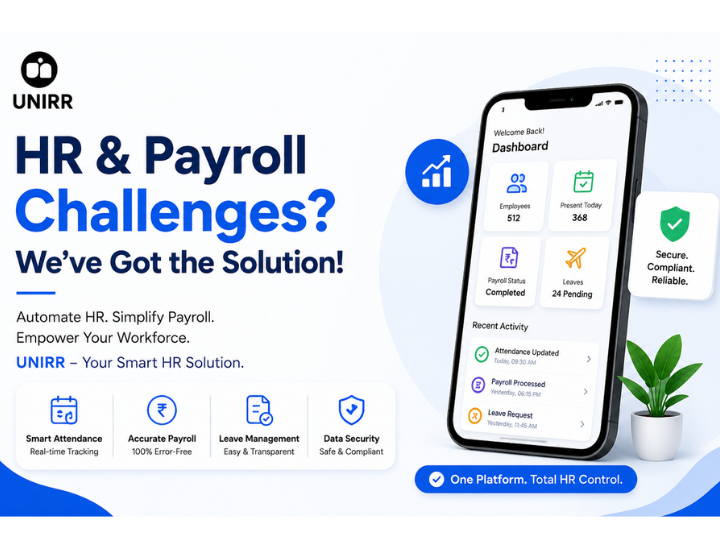
Unirr helps businesses simplify payroll operations and reduce manual HR workload. It automates salary calculations, tax deductions, attendance tracking, and compliance management from one platform.
Unirr helps companies manage PF, ESI, TDS, and multi-state payroll requirements more accurately. Its payroll management software reduces errors, improves salary processing speed, and keeps payroll operations organized.
The platform also integrates attendance, leave management, and employee records with payroll processing. This helps businesses improve payroll accuracy, employee experience, and compliance management easily, while also addressing key HR and payroll challenges.
How Unirr Supports Businesses
- Automates payroll calculations and salary processing efficiently.
- Reduces payroll errors and compliance risks significantly.
- Integrates attendance, leave, and payroll systems smoothly.
- Simplifies PF, ESI, TDS, and tax management processes.
- Improves employee experience with self-service payroll access.
- Supports multi-location and multi-state payroll operations easily.
Final Thoughts
There has been a trend towards increased complexity in Indian payroll management due to factors such as compliance, taxation laws, and employee structure. Manual payroll management increases chances of mistakes, delays in paying employees, and even non-compliance with certain laws.
The best payroll management software ensures that organizations benefit in terms of automation, accuracy, compliance, and improved employee experience. The ideal payroll management software should also facilitate attendance management, tax management, and payment of salaries through one platform.
When choosing the right payroll management software for an organization, there are various factors to consider. These include the degree of automation, compliance, attendance management, self-service options by employees, and reporting features. The best HR payroll software can ensure business success.